Project Search
No Results Found
Search Results - Blog
Search Results - FAQs
No Results Found
No Result Found
The Journal - 13th February 2026
The Economics of Self-Contained Residential Communities in Dubai
<img loading="lazy" src="/sites/default/files/2026-04/Banner_4.jpg" width="1920" height="1080" alt="The Economics of Self-Contained Residential Communities in Dubai" />
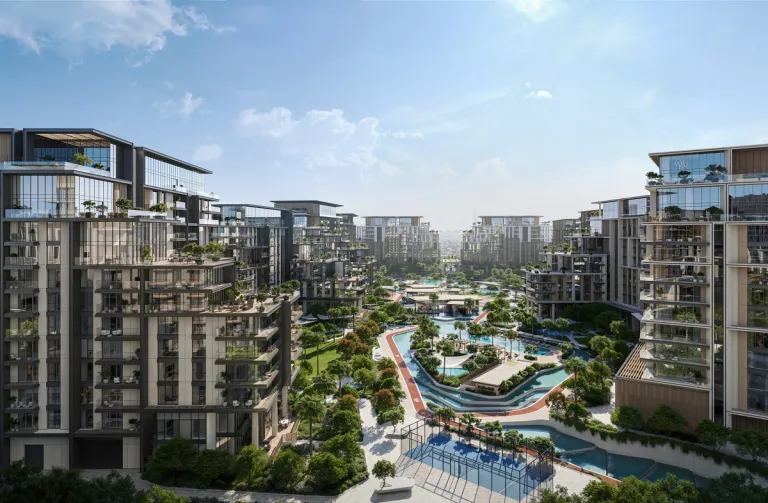
<p>Dubai’s most resilient residential districts are increasingly behaving like small cities, where daily needs, leisure, work-adjacent amenities, and mobility are designed to function together. Buyers and tenants now have more choice than ever, which makes clarity of value the decisive advantage. Self-contained communities often convert that advantage into pricing power by reducing lifestyle friction, stabilising demand, and supporting repeatable performance across cycles.</p>
<h2>What Is a Self-Contained Residential Community in Dubai?</h2>
<p>A self-contained residential community in Dubai is a master-planned district where homes, daily retail, services, leisure, and mobility are integrated allowing residents to meet most everyday needs locally.</p>
<h2>Why Self-Contained Communities Are a Defining Trend in Dubai</h2>
<h3>The Shift From “Address” To “Complete Lifestyle Ecosystem”</h3>
<p>Premium demand in Dubai is less about a single building and more about the system around it: daily retail, walkable streets, wellness, education access, and curated public realm. This preference aligns with a city that continues to scale as a global destination, as <a href="https://www.dubaidet.gov.ae/en/newsroom/press-releases/dubais-tourism-industry-achieves-third-successive-record-breaking-year">Dubai welcomed 19.59 million visitors in 2025</a>, reinforcing the depth of activity that high-quality mixed-use districts can capture and convert into spend and repeat visitation.</p>
<h3>How Time-Savings, Convenience, And Quality-Of-Life Translate into Value</h3>
<p>When residents can meet daily needs on foot, commute more predictably, and access services without cross-city travel, the “hidden costs” of time and friction fall. That matters in a city where mobility demand is rising: <a href="https://www.rta.ae/wps/portal/rta/ae/home/news-and-media/all-news/NewsDetails/802-million-riders-used-public-transport-shared-mobility-and-taxis-in-2025">Dubai recorded 802 million riders</a> across public transport, shared mobility, and taxis in 2025, with average daily ridership around 2.2 million. In real estate terms, lower friction typically widens the tenant pool, improves retention, and supports more predict1able occupancy performance.</p>
<h3>Why Masterplanning Matters More in aHigh-Supply, Choice-Rich Market</h3>
<p>Dubai’s supply pipeline is substantial, but delivery is uneven. In a market where new options continuously compete for attention, communities with coherent design codes, strong operations, and protected public realm tend to be easier for buyers and tenants to assess, compare, and choose.</p>
<h2>What Makes a Community Truly Self-Contained?</h2>
<h3>The Essential Components: Living, Retail, Services, Leisure, And Mobility</h3>
<p>Self-containment is not defined by the quantity of amenities but by complete everyday functionality. The core components typically include:</p>
<ul>
<li>Daily-need retail and services, and destination-led offerings</li>
<li>Education, wellness, and recreation</li>
<li>Public realm quality: shade, walkability, and social comfort</li>
</ul>
<h2>The Difference Between “Amenities” And A Functioning Ecosystem</h2>
<p>A building can have a pool and a gym; a community ecosystem creates routines. The difference is operational:</p>
<h2>The Role Of Community Management and Operational Consistency</h2>
<p>Reliable maintenance, clear rules, responsive service, and consistent standards protect the lived experience. For investors, this supports brand equity and reduces downside risk, because the “product” remains legible and dependable across years, not just at handover.</p>
<h2>Programming And Experience Curation: Creating Repeat Visitation And Loyalty</h2>
<p>Events, seasonal programming, pop-ups, family activities, and curated retail mixes convert a place into a habit. Evidence of this “repeat engine” is visible in Dubai’s leading lifestyle destinations: Emaar reported Dubai Mall footfall of 111 million in 2024, alongside 98.5% average occupancy across its mall assets, illustrating how strong curation and operations can sustain both visitation and commercial performance.</p>
<h2>The Economic Logic: How Self-Contained Communities Create Pricing Power</h2>
<h3>The Value Chain From Design to Demand</h3>
<p>Self-contained communities monetise a simple value chain: design quality → reduced friction → repeat usage → stronger demand → pricing power.</p>
<h3>Reduced Friction in Daily Routines Increases Willingness to Pay</h3>
<p>When a community reduces the everyday “cost of living” in time and effort, it can support higher rents and higher sales prices.</p>
<h3>Stronger Emotional Attachment Supports Longer Holding Periods</h3>
<p>Place identity, created through the public realm, cultural cues, and consistent experience, can increase resident attachment. Longer holding periods reduce resale supply “churn,” which tends to support price stability.</p>
<h3>Better Liveability Widens the Tenant and Buyer Pool </h3>
<p>Liveability attracts residents and retains tenants who might otherwise exit at lease renewal. <a href="https://cavendishmaxwell.com/insights/market-reports/residential/dubai-residential-market-performance-fy-2025">Citywide yield data</a> provides a useful benchmark: Cavendish Maxwell reported gross yields of ~7.0% for apartments and ~4.8% for villas/townhouses in 2025. In self-contained communities, the aim is not only yield level, but yield durability, consistent leasing velocity and reduced vacancy drag.</p>
<h2>Scarcity And Planning Discipline as a Long-Term Advantage</h2>
<p>In premium segments, scarcity is often designed, not accidental. Planning discipline can preserve the characteristics that tenants and buyers repeatedly pay for.</p>
<h3>Controlled Supply, Coherent Design Codes, And Protected Views</h3>
<p>Communities that manage density, protect view corridors, and enforce design guidelines can sustain a stable “visual identity” over time. That identity becomes a pricing support mechanism.</p>
<h3>Why “Replaceability” Drives Liquidity And Resale Premiums</h3>
<p>If a home is easily replicated by comparable inventory nearby, it competes on price. If it sits within a distinctive ecosystem that cannot be quickly reproduced, because land use, street networks, retail mix, and operations are integrated, it competes on value. That difference often shows up in liquidity during slower periods, when buyers become more selective.</p>
<h2>Demand Mechanics: Footfall, Frequency, And The ‘Spend-Stay’ Effect</h2>
<h3>Why Repeated Visits Matter More Than One-Off Crowds</h3>
<p>Frequency underpins stable retail sales, steady service demand, and a lived sense of activation that supports residential appeal.</p>
<h3>How Active Streets Support Perceived Value for Nearby Homes</h3>
<p>Active streets signal desirability: occupancy, safety, maintenance, and social proof. In premium contexts, this must feel curated so vibrancy reads as quality.</p>
<h2>Residential Outcomes: Pricing, Rental Demand, And Liquidity</h2>
<h3>Capital Value Effects: What Typically Drives the Premium </h3>
<p>In Dubai, broad market momentum has been strong. <a href="https://valustrat.com/pages/dubai-residential-values-rise-20-percent-jan-2026">ValuStrat</a> reported the VPI showing ~19.8% annual appreciation (Jan 2026). Within that cycle, self-contained communities tend to outperform when they <a href="https://meraas.com/en/latest-post/journal/how-masterplans-influence-appreciation">translate lifestyle value into repeatable demand</a>.</p>
<h3>Place Identity and Brand Equity asValuation Support</h3>
<p>A recognisable identity reduces perceived risk: buyers understand what they are buying into, and tenants understand what they are renting into. That clarity becomes more valuable as supply expands.</p>
<h3>Leasing Performance: How Self-Containment Influences Rental Outcomes </h3>
<p>Citywide yields <a href="https://dmo.dof.gov.ae/en/news-and-publications/latest-press-releases/dubai-s-real-estate-market-records-new-historic-milestone-with-transactions-exceeding-aed917-billion-usd-2497-bn-in-2025">remain a practical reference point</a> (apartments around 7.0%, villas/townhouses around 4.8% in 2025). Self-containment can support <a href="https://meraas.com/en/latest-post/journal/steady-rental-income-through-buy-let-dubai">rental outcomes</a> through lower friction and stronger desirability, but performance is ultimately driven by tenant profile fit, unit mix, and operational consistency.</p>
<h3>Liquidity And Exit Optionality</h3>
<p>Liquidity is where “economics” becomes real for investors: the ability to exit at a fair price, within a reasonable time, without heavy discounting.</p>
<h2>A Repeatable Framework for Choosing Resilient Communities</h2>
<p>Self-containment performs best when it is designed and operated as one system. Every day retail creates routine footfall, a high-quality public realm keeps people lingering, and consistent management protects the experience residents pay for. </p>
<p>In a choice-rich market, communities that reduce friction and sustain repeat demand tend to hold pricing and liquidity more confidently across cycles. <a href="https://meraas.com/en/project-listing">Explore Meraas’ residential communities in Dubai</a> redefining urban living and discover how design-led masterplanning can support long-term liveability and investment resilience.</p>
<h2>FAQs</h2>
<h3>1.What qualifies as a self-contained residential community in Dubai?</h3>
<p>A self-contained community combines homes with everyday retail, services, leisure, and strong public spaces, so residents can handle most daily needs locally without frequent cross-city travel.</p>
<h3>2.Do self-contained communities typically command a pricing premium?</h3>
<p>They can, especially when the ecosystem truly works day to day, and operations stay consistent. Any premium typically comes from lower lifestyle friction, stronger tenant retention, and a clearer place identity that sustains demand as supply grows.</p>
<h3>3.How should investors weigh service charges against rental performance?</h3>
<p>Investors should judge service charges against net rental returns, not gross yields. Higher fees can be justified when they protect the lived experience supporting occupancy, rents, and lower vacancy over time.</p>
Back to Media