Project Search
No Results Found
Search Results - Blog
Search Results - FAQs
No Results Found
No Result Found
The Journal - 30th March 2026
What Makes a Residential Community Globally Competitive?
<img loading="lazy" src="/sites/default/files/2026-04/Banner_10.jpg" width="1920" height="1080" alt="What Makes a Residential Community Globally Competitive?" />
<p>A globally competitive residential community is not defined by branding alone. In practice, it competes for residents, capital, and long-term relevance against the best urban districts internationally, which means it must deliver strong daily liveability, reliable operations, and durable value through changing market conditions.</p>
<h2>What Globally Competitive Actually Means In Residential Real Estate</h2>
<h3>Competing On Outcomes, Not Marketing: Liveability, Liquidity, And Long-Horizon Value</h3>
<p>In residential real estate, “globally competitive” means producing outcomes that sophisticated buyers can measure: strong occupancy, resilient resale demand, pricing power,an experience designed to support longer holding periods. . </p>
<p><a href="https://meraas.com/en/latest-post/journal/guide-meraas-top-waterfront-developments-dubai">Communities that combine convenience</a>, design quality, and operational discipline tend to widen their buyer and tenant pool, which improves liquidity when owners decide to exit. That logic is especially relevant in Dubai, where <a href="https://www.savills.com/research_articles/255800/386528-0">Savills</a> reported that residential transactions surpassed 200,000 in 2025 and off-plan sales accounted for 72% of activity, underscoring how selective buyers are about where future demand is likely to concentrate. .</p>
<h2>The Demand Engine: Why People Choose to Live There (and Stay)</h2>
<h3>Daily-Life Convenience: Schools, Healthcare, Retail, Parks, And Family Infrastructure</h3>
<p>The clearest sign of a competitive community is that it reduces daily friction. When high-quality schools, healthcare, retail, and green space sit within an efficient routine, the community becomes easier to live in for families, professionals, and long-term residents. That broadens demand beyond short-term investors. <a href="https://media.dubaiairports.ae/dxb-records-highest-annual-traffic-in-2024-celebrating-a-decade-as-the-worlds-busiest-international-airport">Dubai’s private school sector reached 227 schools</a> and 387,441 students in the 2024–25 academic year, while the emirate recorded 5,372 licensed healthcare facilities in 2024. Depth of education and healthcare infrastructure matters because it anchors residential demand, converting a location from an attractive address into a workable long-term base.</p>
<h3>Mobility And Connectivity: Commute Reliability, Last-Mile Access, and Airport Reach</h3>
<p>Connectivity is not just about distance on a map. It is about time certainty. Communities that offer predictable commutes, practical last-mile links, and fast airport access usually support stronger demand because they save time repeatedly, not occasionally.</p>
<p>In global cities, that convenience becomes monetisable: residents are more willing to pay for locations that simplify work, travel, and family logistics. In Dubai, rising population and record airport throughput reinforce the premium attached to well-connected districts, particularly for buyers whose lifestyles span multiple cities.</p>
<h2>Place Quality That Holds Up Over Time </h2>
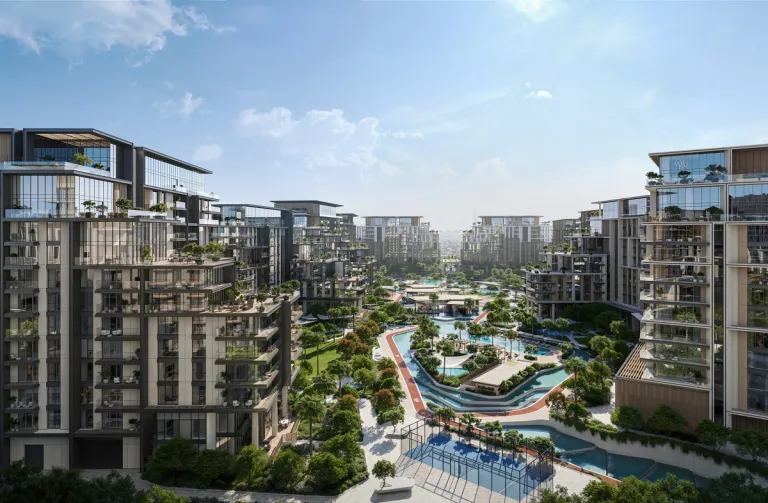
<p><a href="https://meraas.com/en/latest-post/journal/rise-experience-driven-real-estate-developments-dubai">Competitive communities</a> do not rely on individual homes alone. They create public environments that remain comfortable and attractive after handover. Walkable routes, shaded streets, legible landscaping, and safe pedestrian movement extend dwell time and shape how residents interact with the neighbourhood every day..</p>
<p>That matters for value because a good public realm supports tenant retention and resale confidence. It also protects a community from becoming visually dated too quickly, which is one reason master-planned districts with coherent design frameworks tend to age more gracefully than purely transactional developments.</p>
<h2>Governance And Operations as a Competitive Advantage</h2>
<h3>Management Standards: Cleanliness, Security, Landscaping, and Rapid Issue Resolution</h3>
<p>Operational quality is one of the least glamorous but most important drivers of long-term competitiveness. Buyers may be attracted by design first, but they stay because the community works. Cleanliness, security, landscaping quality, and fast issue resolution shape resident satisfaction and renewal behaviour. Over time, these factors influence reputation, vacancy, and resale sentiment.</p>
<p>For internationally mobile buyers, strong management also reduces perceived execution risk, which is critical in markets where governance quality can vary sharply from one community to another. <a href="https://dubailand.gov.ae/en/news-media/dubai-s-real-estate-sector-records-aed761-billion-in-transactions-in-2024">Dubai’s record 217,000 investments</a> worth AED 526 billion in 2024 suggests that confidence is increasingly tied to transparent, professionally run environments rather than headline marketing alone.</p>
<h3>Service Charges and Asset Preservation: Value-For-Money, Transparency, and Reserve Funding</h3>
<p>High service charges do not automatically weaken competitiveness; poor value-for-money does. What matters is whether charges are transparent, justified, and visibly reinvested in asset preservation. <a href="https://dubailand.gov.ae/en/eservices/service-charge-index-overview">Dubai’s Service Charge Index</a> and the <a href="https://mollak.dubailand.gov.ae/publicpages/home.html">Mollak system</a> are important because they give buyers a clearer framework for reviewing approved fees and how jointly owned property charges are monitored.</p>
<p>That kind of transparency matters in premium residential real estate: communities that underfund maintenance often look cheaper initially but erode faster, while communities that manage charges credibly tend to preserve both experience quality and long-term asset value.</p>
<h2>The Global Competitiveness Formula</h2>
<p>A residential community becomes globally competitive when it combines four things: strong daily liveability, dependable connectivity, design quality that holds its identity over time, and governance that protects standards after handover.</p>
<p>In other words, the strongest communities do not merely attract attention; they keep residents, support liquidity, and preserve relevance through market cycles. For buyers assessing Dubai real estate investment opportunities, that is the real test of whether a location can compete internationally rather than only locally. <a href="https://meraas.com/en/project-listing">Explore Meraas communities</a> redefining urban living.</p>
<h2>FAQs</h2>
<h3>1.What Are The Clearest Signs A Community Will Remain Competitive In 10 Years?</h3>
<p>The clearest signs a community will remain competitive over a decade are strong access to schools and healthcare, efficient connectivity, coherent design, high-quality public spaces, and professional management with transparent service charges.</p>
<h3>2.Do Globally Competitive Communities Typically Hold Value Better During Corrections?</h3>
<p>They often do, because they attract broader and stickier demand. A community with real livability, strong operations, and limited substitutability tends to see less severe demand deterioration than a location driven mainly by launch momentum or marketing.</p>
<h3>3.How Can Buyers Evaluate Governance And Management Quality Before Purchasing?</h3>
<p>The most reliable indicators are practical rather than promotional: review approved service charges, study maintenance standards in existing phases, assess cleanliness and landscaping consistency, and check whether management systems are transparent and responsive.</p>
Back to Media